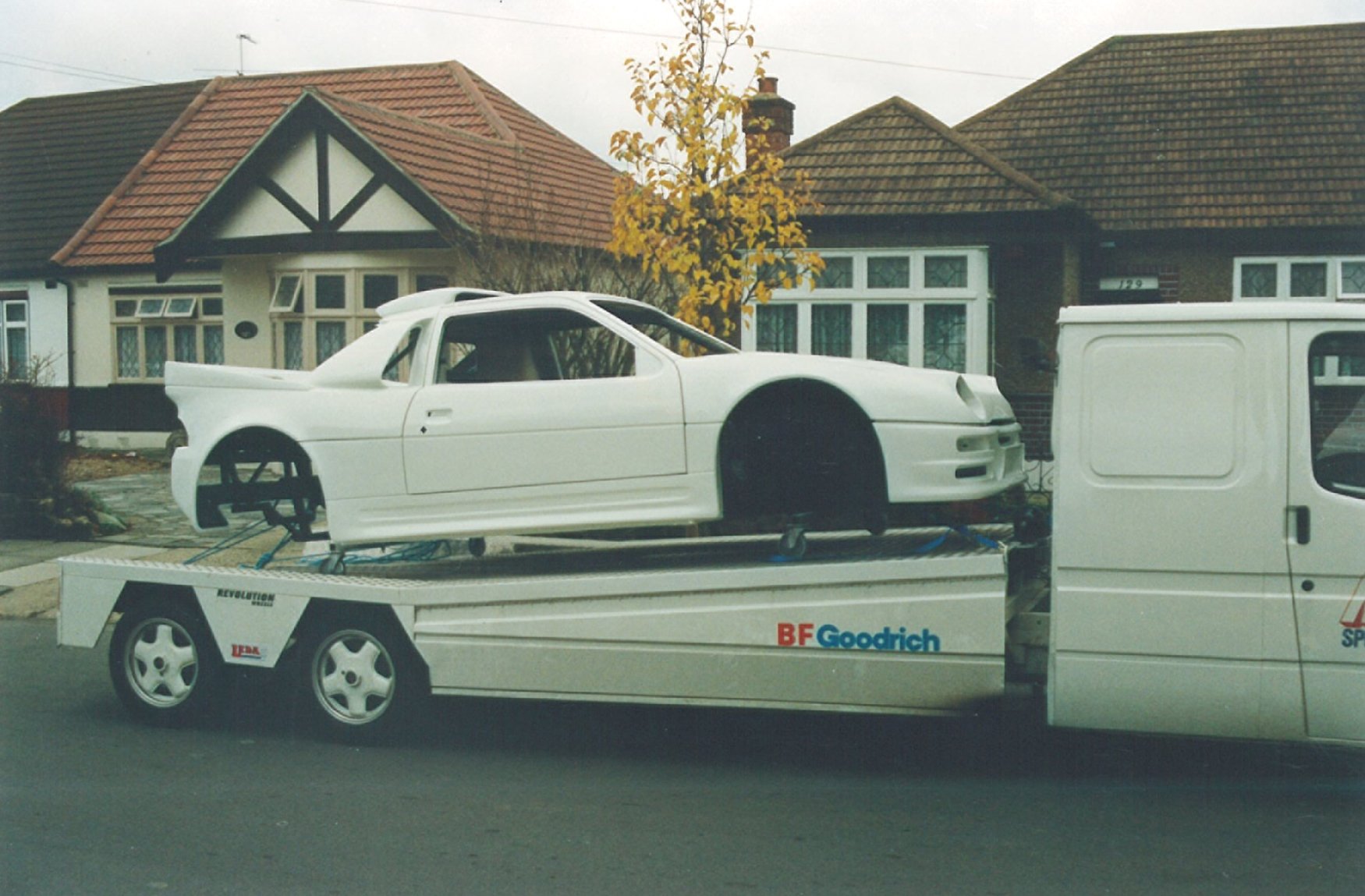
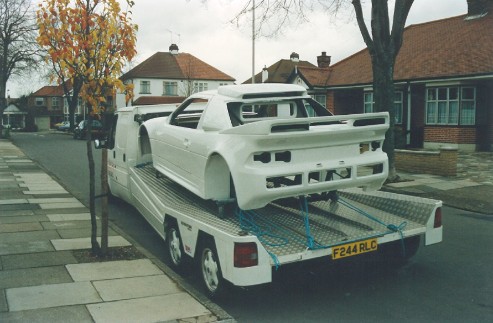
 The body and chassis arrive 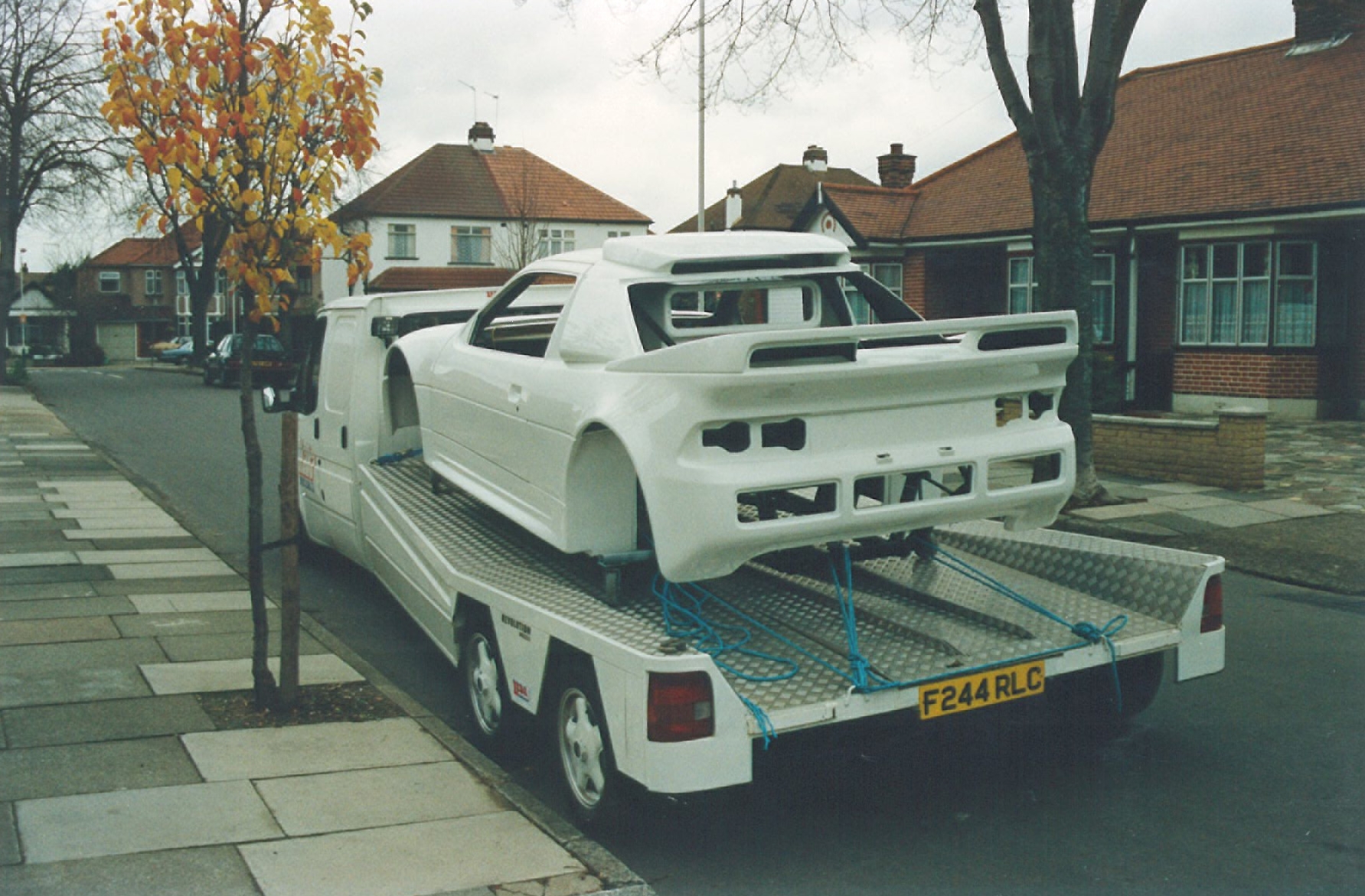 The body and chassis arrive  Add a couple of stickers |
C106 GRH Back in November 1984 I tore an article from a magazine detailing the development of Ford's new rally car, the RS 200. This feature found its way into a folder where it was to stay, unread, for the next seven years. In the course of those 7 years the rally project came to fruition, achieved success and was curtailed before it could achieve its full potential. As its name suggests only 200 of these fabulous machines were ever produced although, if popular rumour is to be believed, when the man from the FIA went to count the cars at the assembly line, those in the far corner were powered by nothing more than a trestle table with packing case interiors. Of the original 200 cars 46 were cannibalised for spares and only 52 of the cars which had been converted, many by Tickford, to road specification were sold in Britain. Originally with a price tag of £50,000 their price rose, in the late 80s, at the height of the car collecting boom, to an asking price around £150,000. At a Bitterly cold car show on North Weald Airfield in June 1991 I met John Cooke, the man behind the European Kit Car show, and through him, Richard Sellicks who at that time was developing a car which, although different to the RS 200, looked remarkably similar. At the European Kit Car show the following month a prototype chassis had been produced, and fitted out with Cosworth Sierra suspension, seats and dashboard. I sold my Stardust D-type at the show and was totally hooked on producing my own RS 200 look-alike. That autumn and winter saw the construction of a Grasshopper - an electric powered, 7-style car for my daughter. In the spring of 1992 the Stoneleigh show saw the public debut of the Kara 430, as Richard's car was initially known. Without doubt, the stunning white car was the star of the show judging by the crowds it drew and the brilliant, positive coverage afforded it by the Kit Car press. I was even more convinced by now that this had to be my next build; I have built to date three Westfields, an MGB based NGTC and a Stardust D-type. One small problem remained before a final decision could be taken - would the car fit in the garage? A scale plan of the car, garage and driveway were made to see if everything would fit. Did you know that Christopher Wren made scale models of St-Pauls Cathedral to see if he could get the bells into and up the bell towers? My scale plan idea was equally successful and led to an extension being built on the side of the garage. By now the demonstrator was running and, as we live only 25 miles from the Southend factory, I invited Peter Baisden; the chassis designer, to bring the car home to see just whether it would fit into my garage. After some careful maneuvering the car sat squarely in place - final problem solved and an - order was duly placed. By early November the body and chassis were ready for painting in the Eurosport workshop (where the body is made). I visited the paintshop a couple of times just to watch their progress; at last, almost 18 months after learning of the car's existence, my kit was due for delivery. At the time it was somewhat frustrating having to wait whilst this and that was sorted out, but with hindsight it was worth the wait to have a kit on which everything worked and fitted together without the usual problems which can beset a new product. When it was delivered, the gleaming white body was attached to the jet black chassis, the first job was to remove the front and back sections and stand them in the dining room where they were both to remain for the next six months. The rolling chassis was achieved in no time at all and by way of light relief the door handles, locks and electric windows were the next things to receive attention. The sense of achievement when the glass ran up and down in the windows and the other door furniture all worked was immense and totally out of proportion to its actual importance. However, these features all contributed considerably to the sense of progress. The Sierra Cosworth dash and steering column were fitted along with the pedal box which was altered to enable the clutch to operate a hydraulic master cylinder fitted to the front bulkhead. The logic behind this innovation is that the Renault Gearbox is hydraulically operated and, in any case, it is too far removed from the footwell to be cable operated. When deciding on the car's specification I considered carefully what engine to opt for. Cosworth power or perhaps a 2-litre weber set up? At last I decided to go for a 2-litre fuel injection unit along with a 5-speed Renault 20 UN1 gearbox. The wiring loom, and ECU both came from a 2.litre injection Sapphire and putting the engine in the back instead of the front meant altering the wiring loom to reposition the module. I could make this sound immensely complicated and technically difficult but in reality it was just a case of making up a six foot, seven wire extension to the loom and fitting the engine management box to the inside of the rear bulkhead. To this same bulkhead and behind the drivers seat, were fitted two Sierra bonnet release units, each of these operated a bonnet lock on either side of the rear bodywork the driver's side has an additional safety catch to prevent the back-end flipping open when it shouldn't. The backs on the first few Ford RS200 cars opened in this direction but an unfortunate experience with someone forgetting to shut the back correctly brought about a rethink, hense the Ford cars are top-hinged along the roof line. The cooling and heater pipes were laid in the centre tunnel, along with the servo vacuum supply, brake and clutch pipes, electrical supply to and from the engine, handbrake cable and last of all, the gearchange assembly. The Ford engine was mated to the Renault gearbox by means of a purpose cast bell housing and the whole assembly then slipped into the chassis. The driveshafts are Sierra Cosworth units, not the usual one long one short combination but 2 long shafts along with a couple of Renault to Ford gearbox output adaptors. With all the services fitted and tested it was time to fire up the engine for the first time. After a couple of attempts the engine started, revved up and died, this continued to happen regardless of all attempts to cure the problem. Frustration set in and the services of an electrician (I had decided it was an electrical problem) were sought. A young electrician called Dave, who has worked on the original Kara demonstrator, arrived on his motorbike armed with a small box of tools. Dave looked at and listened to the engine as it refused to run for more than a couple of seconds. In no time at all he took a feeler gauge and poked it in a hole between the injection unit and the engine head. I had used a carburetter manifold gasket not an injection one, and this gave rise to 4 large holes through which, on starting up, rushed lots of air, hence the revving and dying. It took a further 30 minutes to fit the correct item and then try again, this time success was instant and the management system took it upon itself to set up and learn all the necessary settings - very clever. By now it was mid July and the car was trailored back to the factory Southend to be trimmed; again by a chap who had worked on the original demonstrator. After three days trimming and with all the body panels now fitted I drove around the factory car park, the car under its own power and semi complete, for the very first time. A great sensation. From the factory we took the car to a Kit Car show at Wembley conference centre. It is perhaps opportune to reflect on some of those gallant souls who have helped out over the last couple of years. First off, all the lads from Mercury Motor Sport, who produce the 200 kit, deserve a big thank you for always being ready to help at the other end of the phone or even driving up from Southend to lend a hand on a couple of occasions. Another vote of thanks goes to John Bass of Woodlands Motor Spares who at the drop of a "John could you spare a couple of minutes" would regularly let himself in for a few hours work. Last but by no means least my thanks go to a band of my colleagues from the Engineering department at Hackney Community College for their help with various odds and ends and for not chasing me off their machines in the workshops. The following month I had the splendid opportunity to run the car at Mallory Park during a test day organised by some of the leading players on the kit-car scene. Great fun; I probably recorded slowest time of the day because the engine was still being run in (that’s my excuse). However, I kept one eye on the rear view mirror, kept well out of everyone's way and enjoyed myself no end. Since the Mallory drive I have driven my 200 at Castle Combe and Donnington Park and put the car on show at the Brands Hatch Rallycross Grand Prix and the Mercury Motorsport stand at the Stonleigh Kit Car show.
   |
